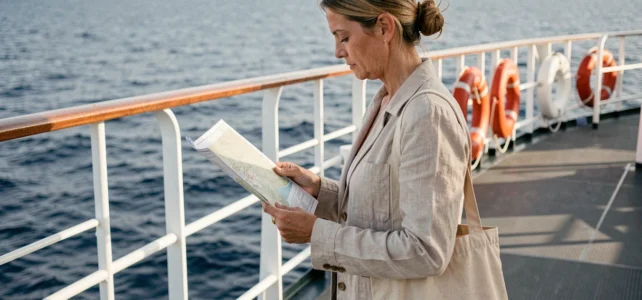
On a a ferry, not all spots on the deck are equal. The wind, the sun, the noise of the engines, and even the proximity to emergency exits can radically change the comfort of a crossing. Whether you are heading to Corsica, Sardinia, or the Greek islands, choosing your spot on the outdoor deck deserves a few minutes of thought before boarding.
Wind and fumes on the ferry deck: areas to avoid first
Have you ever noticed that persistent smell of diesel near a ship’s smokestacks? The areas located just below or near the exhausts receive fumes continuously, especially when the wind is blowing from the stern.
Recent incidents on ferries in Indonesia (summer 2026) have shown that spaces close to the smokestacks and garage accesses quickly become unbreathable in case of a technical problem. Passengers positioned on the side decks or at the back, away from the smoke flows, remained in much safer conditions.
For an ordinary crossing, the principle remains the same. Before laying down your towel, check the wind direction in relation to the smokestacks. If the wind is coming from the back of the ship, the fumes rise towards the bow: settle on the sides or at the front instead. If the wind is coming from the front, the back will be clearer.
To choose your spot on the ferry deck well, you also need to consider the duration of the crossing: on a journey of several hours, a slight olfactory discomfort at the start becomes quite unpleasant by the time you arrive.
Ferry deck location and thermal comfort: shade versus sun
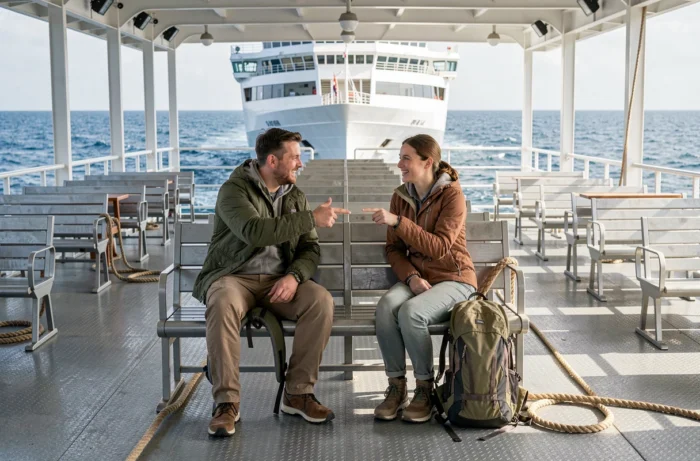
In summer, the temperature on a deck exposed to the south can rise very quickly. The metal of the seats and railings accumulates heat, and the reflection from the sea amplifies UV exposure.
Why does this choice between shade and sun matter so much? Because a crossing to Corsica from Toulon or Nice lasts long enough to get a serious sunburn, even with sunscreen.
Here’s how to spot the best shaded areas:
- The overhangs of the upper decks create natural bands of shade on the lower decks, often on the port or starboard side depending on the ship’s orientation
- The awnings and canopies installed by some ferry companies cover part of the outdoor seating, but these spots fill up very quickly after boarding
- The areas near the interior bulkheads offer partial shelter from the wind and sun while still remaining outside
Shaded spots are taken within the first minutes after boarding. If you are traveling in summer, head to the deck as soon as access is open, even before settling inside.
Outdoor seats and engine noise: locating the quiet areas of the ship
The noise on board a ferry does not come solely from the engines. The propellers, ventilation systems, and the movement of passengers generate a background noise that varies depending on where you are seated.
The stern concentrates the vibrations from the propellers and mechanical noise. The further you move away from the back, the lower the noise level becomes. The decks located in the middle of the ship, at mid-length, generally offer the best compromise between calm and stability.
Stability, indeed, is a criterion that many forget. The center of the ship corresponds to the point of least rolling. If you are sensitive to seasickness, avoid the bow and the stern, and prefer the middle of the deck. This area moves less when the sea is rough, making the journey significantly more bearable on long crossings.

Night crossing on the ferry deck: cabin, reclining seat, or outdoor deck
For a night journey to Corsica from Marseille or Toulon, the question of location takes on a different dimension. Sleeping on the outdoor deck is technically possible, but comfort remains very limited.
The temperature drops significantly at sea after sunset, even in the middle of summer. The apparent wind generated by the ship’s speed further cools the atmosphere. Without a thick blanket and warm clothes, spending a night on the outdoor deck becomes uncomfortable within the first hour.
If your budget does not allow for a cabin, the reclining seats inside the ship offer a reasonable compromise. Most companies serving Corsica (Corsica Ferries, Corsica Linea, La Méridionale) offer this option at a price intermediate between deck passage and cabin.
Here are a few points to check before booking a “deck passage” ticket for a night crossing:
- Some companies close access to the outdoor decks at night for safety reasons
- The common interior spaces (lounges, cafeterias) can be noisy and brightly lit at all times
- Electrical outlets for charging a phone are rare on the decks, more common in the lounges
Evacuation preparation: a criterion often overlooked
Since January 2024, international requirements of the FAL convention mandate enhanced electronic exchange of passenger data. This evolution reflects a growing focus on safety and management of flows on board.
In practice, spotting the emergency exits and assembly points as soon as you arrive on the deck is a useful reflex. Locations close to the stairs and lifeboats allow for quicker reactions in case of an alert, without having to cross the entire ship through the crowd.
This criterion should not become an obsession, but it can differentiate two equivalent spots in terms of comfort. When comfort is equal, prefer the one that gives you clear access to a stairway or exit.
Ultimately, choosing a spot on a ferry deck relies on three concrete parameters: the wind direction in relation to the fumes, the position in relation to the center of the ship for stability, and the proximity to a shaded area during the day. Identifying these three elements in the first few minutes after boarding makes the difference between a pleasant crossing and several hours of discomfort.