
Whey and creatine play a central role in sports bags, but they do not act on the same physiological mechanisms. One provides amino acids to rebuild muscle, while the other is involved in energy production during brief, intense efforts. Comparing these two supplements without understanding their mode of action is like contrasting a building material with a fuel.
European regulatory framework: what creatine is allowed to promise
Content comparing whey and creatine rarely goes through regulatory scrutiny. In the European Union, only two health claims are allowed for creatine.
The first: creatine increases physical performance during repetitive, high-intensity, short-duration activities, provided there is an intake of 3 g per day for adults engaging in this type of effort.
The second, more recent claim, concerns adults over 55 years old: daily creatine consumption can enhance the effect of resistance training on muscle strength, again at a dosage of 3 g per day, with training at least three times a week and progressive loads at 65-75% of 1RM.
Any mention of cognitive effects or benefits for long-duration endurance falls outside this legal framework. Articles that discuss these avenues without specifying their regulatory status create a confusion that the reader deserves to see clarified. To delve into the differences between creatine and whey, it is useful to start from these regulatory bases before assessing the benefits of each supplement.

Whey protein: role in muscle reconstruction after effort
Whey is a concentrated protein derived from whey. Its profile of important amino acids, particularly BCAAs (leucine, isoleucine, valine), makes it a post-workout intake particularly suited for muscle protein synthesis.
Its rapid digestion allows for amino acid availability shortly after exercise. This timing promotes the repair of micro-tears caused by repeated muscle contractions.
Animal or plant proteins: a distinction that is fading
A recent randomized clinical trial shows that plant-based protein blends produce comparable muscle adaptations to animal proteins when supplementing a resistance program. The absolute superiority of whey over plant alternatives, long considered a given, deserves to be nuanced in light of these data.
Whey retains a practical advantage: its concentration of leucine per serving is generally higher than that of plant proteins, simplifying the dosing to reach the threshold for stimulating protein synthesis.
Creatine monohydrate: energy mechanism and safety profile
Creatine is not a protein. It increases phosphocreatine stores in muscle cells, which accelerates ATP (adenosine triphosphate) regeneration during intense contractions. Its preferred domain: short sets, sprints, explosive exercises.
Monohydrate remains the reference form, the most studied and documented. Alternative forms (creatine HCL, buffered, ethyl ester) do not have sufficient data to justify a higher cost.
Side effects: what recent data says
A review covering several hundred clinical trials reports that the most common side effects are gastrointestinal, observed in about 9.9% of the studies analyzed. Renal, cardiovascular, or hepatic events remain rare and without a coherent pattern of dose-related or duration-related toxicity.
The idea that creatine would be dangerous for the kidneys does not hold against this data. However, individuals with pre-existing kidney conditions should consult a healthcare professional before any supplementation.
Combining whey and creatine: protocol and known limits
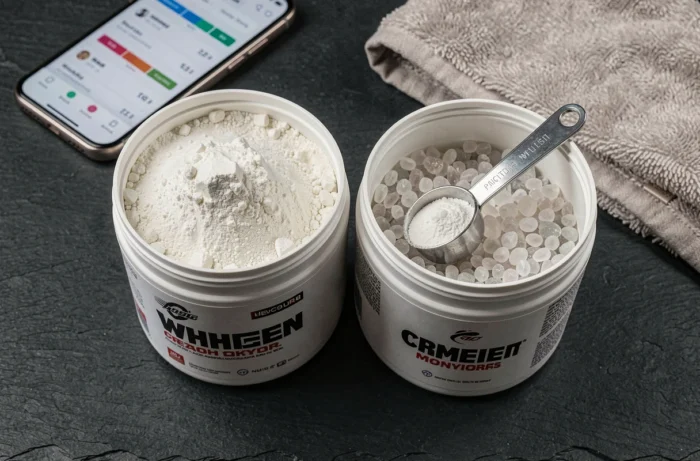
Combining these two supplements is not contradictory as they target distinct mechanisms. Whey provides the protein substrate for muscle building, while creatine supports high-intensity work capacity. One prepares the ground, the other increases the volume of training that can be achieved.
The combined intake post-workout is the most common configuration. A few points deserve attention:
- Creatine does not require a loading phase. A regular intake of 3 g per day is sufficient to gradually saturate muscle stores over a few weeks.
- Whey is dosed based on total daily protein needs, not just the post-session shake. An excess of protein beyond actual needs does not accelerate mass gain.
- Adding creatine to a whey shake does not alter the absorption of either. Both dissolve without notable interaction.
Field feedback varies on the perceived benefit of this combination among beginner practitioners, whose potential for progress primarily relies on training consistency and overall nutrition. A beginner gains more benefits from a balanced diet than from a sophisticated supplementation strategy.
Creatine during cutting: a supplement often wrongly abandoned
Many practitioners stop creatine during a caloric restriction phase, fearing the intracellular water retention it causes. This retention is real but occurs inside muscle cells, not under the skin.
Maintaining creatine during cutting preserves work capacity and limits the loss of strength often associated with caloric deficits. A sudden stop leads to a decrease in phosphocreatine stores within a few weeks, which can reduce performance in the gym at a time when one is precisely looking to maintain the training stimulus.
The decision to stop or continue depends on the visual goal sought in the very short term (the day before a bodybuilding competition, for example) rather than on a fundamental physiological logic.
Whey and creatine do not substitute for each other. The former meets a structural need, while the latter addresses a specific energy need. Choosing between the two is the wrong question: the real issue lies in the coherence between training, basic nutrition, and the precise role that each supplement fulfills.