
Starting a business in La Petite Pierre requires navigating the constraints of a rural Alsatian area where commercial real estate is scarce, the local customer base is limited, and support mechanisms are scattered across various institutional levels. It is better to identify the truly actionable levers before registering your business.
Taxation and exemptions available in the Alsatian rural area
La Petite Pierre is located within the perimeter of the Hanau-La Petite Pierre Community of Communes, an area classified as a rural revitalization zone for many years. Although zoning evolves regularly, this location potentially opens access to exemptions from business property tax and profit tax during the first years of operation.
The ACRE scheme remains a central lever for any entrepreneur, offering a social security contribution exemption for twelve months. The thresholds were raised in 2026, improving the cash flow for micro-entrepreneurs in the launch phase. The ARCE, for its part, now pays 60% of ARE rights in two installments, providing a more substantial equity-like contribution than before.
For project leaders aged 18 to 29, the Grand Est Region offers assistance covering up to 50% of eligible support expenses. This scheme can be combined with honor loans from Initiative Pays de Saverne, which intervenes without requiring personal guarantees. We recommend checking cross-eligibility before applying for a bank loan, as the leverage effect on the financing plan is significant.
The community’s portal centralizes information about La Petite Pierre related to economic procedures and local contacts, which avoids navigating between multiple offices.
Commercial real estate and establishment in La Petite Pierre
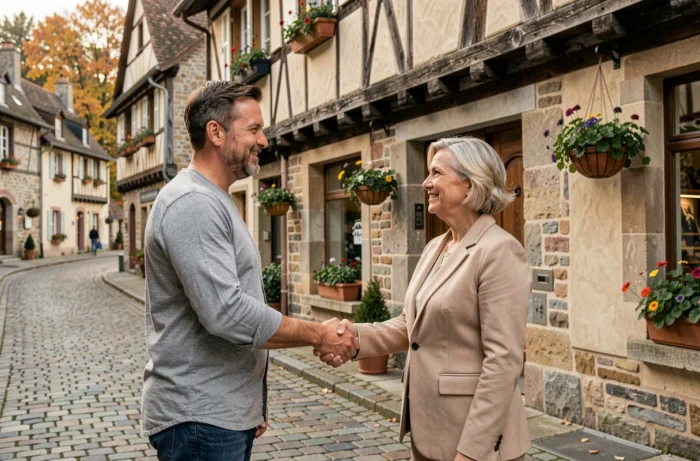
The stock of available commercial and artisanal premises in La Petite Pierre remains structurally low. The municipality has a modest population, and vacant buildings often belong to older constructions, with constraints related to the perimeter of historical monuments (the castle and the medieval district are classified).
Two options deserve priority consideration:
- Taking over an existing business, particularly in the restaurant or tourist accommodation sectors, which are thriving due to the attendance at the Parc naturel régional des Vosges du Nord. This type of transfer benefits from support from Initiative Pays de Saverne and the CCI Alsace Eurométropole.
- Setting up a dematerialized activity (consulting, digital services, e-commerce) that allows you to register your headquarters without depending on a commercial premises. The entry cost is significantly lower, and fiber internet is gradually being rolled out in the area.
- Renting community rooms or shared spaces for occasional activities (training, workshops), a flexible option that limits rental commitment.
The absence of a dedicated business zone in the municipality directs industrial or logistical projects towards neighboring intercommunalities. It is better to incorporate this parameter from the outset of the market study.
Support network: who does what to start a business in Alsace
The institutional network around La Petite Pierre is dense, but each structure operates within a specific scope. Confusing their missions wastes time.
The CCI Alsace Eurométropole handles projects related to commerce, industry, and services. It offers advice on business creation, business diagnostics, and training. The Chamber of Trades of Alsace (CMA) covers artisanal activities, with specific support for the preparation for establishment stage.
ADIRA, the Alsace development agency, intervenes in projects related to establishment, expansion, or investment. Its role is more that of a territorial facilitator than a direct funder. For agricultural or viticultural projects, the Alsace Chamber of Agriculture remains the reference contact.
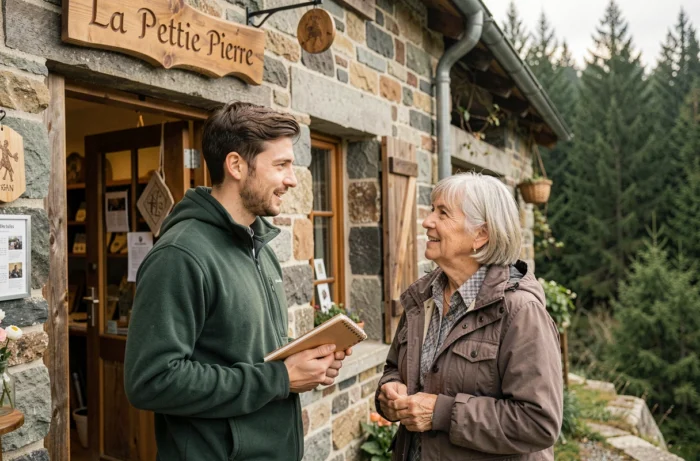
On the financing side, Initiative Pays de Saverne provides honor loans to creators and buyers of small businesses. Adie supports project leaders who do not have access to traditional bank credit, with microloans tailored for very small structures. Bpifrance typically intervenes as a loan guarantee or co-financing for more structured projects.
The Grand Est Region also centralizes its economic mechanisms on the platform be-est.fr, which lists aids for innovation, internationalization, and ecological transition.
Tourism and seasonality: calibrating your economic model
La Petite Pierre attracts a tourist clientele concentrated from April to October, with peaks during cultural events such as the Au Grès du Jazz festival. Any B2C project must account for marked seasonality in its cash flow forecast.
The activities that work best in this type of area combine a summer tourist offer with a local or regional clientele for the rest of the year. A restaurant that relies solely on the summer season will struggle to cover its annual fixed costs. We observe that successful project leaders are those who diversify their revenue sources from the start.
Projects related to ecological transition benefit from a favorable context: national and regional aids are multiplying for rural areas engaged in this approach. An eco-tourism positioning, short circuits, or sustainable craftsmanship can open access to complementary funding lines.
The pool of direct clientele remains limited to a few hundred permanent residents. A viable model relies on at least departmental outreach, whether physically through proximity to Saverne and Strasbourg, or online through a distance selling strategy. Calibrating your break-even point solely on the local population would be a sizing error.