
An employee receives a text message from Health Insurance announcing a video conference check-up in 48 hours. He does not know what the doctor will verify, nor what he risks in case of disagreement. This situation, increasingly common since the generalization of remote monitoring at the end of 2025, illustrates a persistent ambiguity surrounding the control doctor, his prerogatives, and his limits.
Remote monitoring of sick leave: what has changed since December 2025
Since December 1, 2025, Health Insurance can verify the validity of a work stoppage via video conference with a consulting physician. Before this date, only in-person appointments and home visits existed. The patient now receives a summons by email and SMS at least two days in advance, along with connection details.
At the end of the interview, the consulting physician determines whether the leave is justified or not. The decision is immediately communicated to the patient and their primary care physician. If the patient refuses or cannot participate in the video conference, an in-person appointment must be offered to them.
This touches on a sensitive point: not everyone has access to suitable digital equipment or a stable connection. To understand precisely the role of the control doctor in this new framework, it is necessary to distinguish what he can demand from what falls under the patient’s rights.
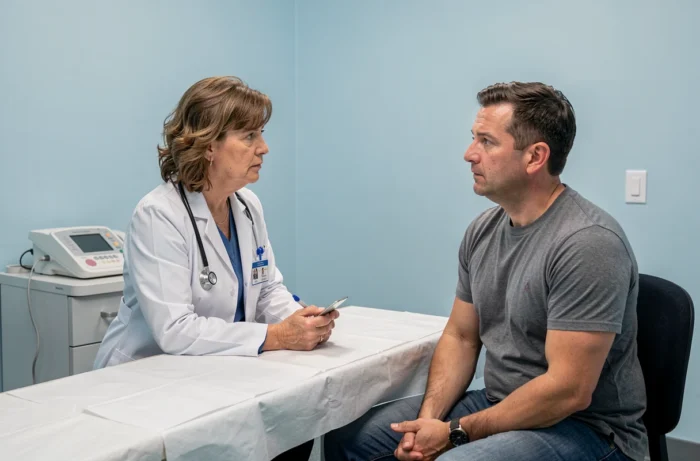
Control doctor and primary care physician: two distinct missions
The confusion between these two roles remains common. The primary care physician treats, prescribes, and monitors the evolution of a pathology. The control doctor, on the other hand, acts on behalf of a third party, whether it be Health Insurance, an employer, or an insurance company.
What the control doctor evaluates concretely
His mission focuses on a specific point: to verify whether the declared inability to work corresponds to the observed health status. He prescribes nothing, does not modify a treatment, and does not replace the primary care physician.
- He examines the patient (in person or via video conference) and reviews the medical documents provided.
- He gives a technical opinion on the justification of the leave, its duration, or its extension.
- He transmits his conclusions to the mandating organization, not directly to the patient in the case of an employer check.
The control doctor has no therapeutic relationship with the patient. This distinction changes everything, especially regarding consent and access to the medical file.
Medical confidentiality and limits of communication
The control doctor is subject to professional secrecy like any physician registered with the Order. He can only communicate administrative conclusions to the employer (leave justified or not, possible date of return). No diagnosis or clinical details can be transmitted to the employer.
Feedback varies on this point: some employees report pressure to provide detailed information during the check-up. In case of doubt, one can remind the control doctor of this obligation of discretion, which is outlined in the medical code of ethics.
Challenging an unfavorable opinion: the patient’s concrete recourse
When the control doctor concludes that the leave is not justified, daily allowances may be suspended. The notification arrives quickly, sometimes on the same day as the remote check-up. One then faces a tight schedule.
Contradictory medical expertise
The patient can request a recourse medical expertise from Health Insurance. An independent expert physician then re-examines the situation. This procedure must be initiated quickly after the notification, or the patient risks losing their benefits.
During this phase, it is essential to gather medical documents from the primary care physician: reports, test results, history of the pathology. The more documented the file, the higher the chances of a favorable outcome for the expertise.
Amicable recourse commission and court
If the expertise does not yield satisfaction, two steps remain possible:
- Contact the amicable recourse commission (CRA) of the health insurance fund, by reasoned letter.
- If rejected by the CRA, bring the dispute before the social division of the judicial court.
- Be accompanied by a recourse consulting physician, freely chosen, who knows the medico-legal evaluation criteria.
Choosing an independent consulting physician changes the dynamics of the recourse. One proposed by an insurance company or employer defends the interests of their mandator, not those of the patient.

Medical control during sick leave: what the patient should prepare
Whether the check-up is in person or via video conference, the preparation remains the same. One does not arrive empty-handed before a doctor whose mission is to decide on the legitimacy of a leave.
Having recent prescriptions, results of additional tests, and any correspondence from the referring specialist on hand is a minimum. The control doctor does not have the complete medical file: it is up to the patient to provide the elements that justify their leave.
For video conference checks, verifying one’s connection and equipment the day before avoids an involuntary absence. A no-show without a legitimate reason can be interpreted as a refusal of the check-up, with possible suspension of benefits.
The control doctor fulfills a specific role in the healthcare system, framed by medical ethics and the texts of Health Insurance. Knowing one’s rights in the face of this control, particularly the right to contest and to be assisted, transforms a stressful summons into a manageable step.