
The electric string trimmer occupies a unique place in gardening tools. While the lawn mower handles most of the work on flat surfaces, the string trimmer comes into play in areas that the mower cannot reach: wall bases, tree contours, flowerbed edges. Its use seems intuitive, but a few adjustments and precautions directly affect the quality of the result and the lifespan of the device.
Wire diameter and motor power: the adjustment that most manuals overlook
The relationship between motor power and cutting wire diameter determines both cutting efficiency and the longevity of the string trimmer. A wire that is too thick on an undersized motor causes motor overheating and premature wire breakage.
For lightweight electric models (under 1000 W), a wire diameter of 1.4 to 1.6 mm is sufficient. Increasing the diameter only makes sense on more powerful machines designed to withstand increased mechanical resistance.
Before knowing how to use an electric string trimmer, it is essential to check this wire/motor compatibility in the manufacturer’s technical documentation. An appropriate wire cuts cleaner, puts less strain on the motor, and reduces vibrations transmitted to the arms.
Wired or battery-powered electric string trimmer: practical implications on the ground
The choice between a wired model and a battery-powered model is not just a matter of convenience. Each imposes different usage constraints that affect the way of working.
Wired model: constant power, limited range
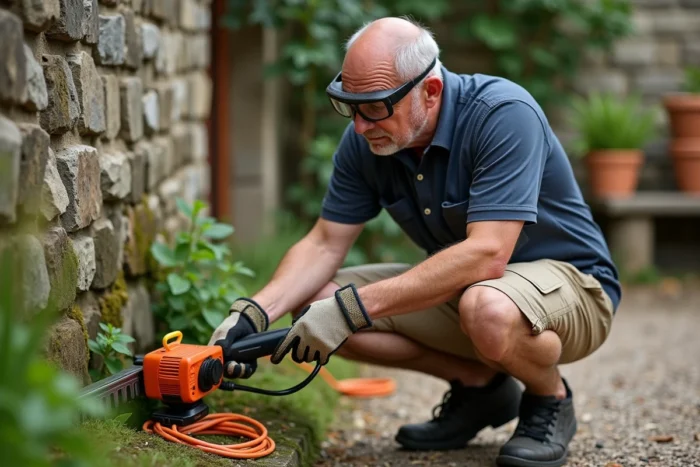
A wired string trimmer delivers stable power as long as it is plugged in. No drop in performance at the end of the session. However, the extension cord limits the working perimeter and poses a ground obstacle that must be constantly monitored to avoid cutting it.
In a small urban garden, this constraint remains manageable. Beyond a certain area, the cable becomes a real hindrance to work fluidity.
Battery-powered model: freedom of movement, variable autonomy
Battery-powered models offer total freedom of movement. The downside: autonomy decreases with the thickness of the vegetation. In tall or dense grass, the motor draws more from the battery, and the effective working time can significantly reduce compared to the optimal conditions advertised.
Field reports vary on this point. Some users report sufficient autonomy for a medium-sized garden, while others notice quick exhaustion as soon as the vegetation exceeds ten centimeters.
Cutting technique with the string trimmer: gesture and angle make the difference
A string trimmer is not operated like a lawn mower. The result depends as much on the gesture as on the machine itself.
- Hold the device slightly tilted (about 30 degrees from the ground) so that the wire attacks the grass from the top without scalping the soil or throwing stones towards the face.
- Work with a regular swinging motion, from left to right, while moving slowly. A too-quick pass leaves clumps intact and requires going over them again.
- Maintain the wire at a constant height by monitoring the protective guard, which serves as a visual guide for the distance to the ground.
- Follow hard edges (walls, slabs) by reducing the speed if the device allows it, to avoid accelerated wear of the wire in contact with the stone.
The direction of wire rotation determines the side of debris ejection. Most string trimmers rotate counterclockwise, which throws debris to the left. Working while keeping the cleared area to the left avoids dirtying flowerbeds or paths that are already clean.
Quick-loading heads: a recent evolution that changes maintenance
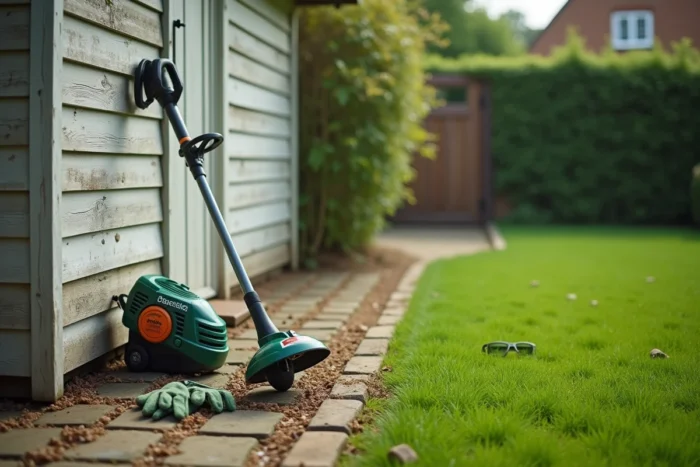
Recent electric models increasingly incorporate quick-loading heads. This system allows for wire replacement without opening the cutting head. A new strand is simply threaded through a designated opening.
The advantage is twofold. Downtime is reduced to a few seconds instead of several minutes for traditional rewinding. Errors in winding (knots, wire crossings, “bird nests”) disappear, as there is no winding at all.
The available data does not allow for a conclusion that this system is suitable for all uses. For thick diameter wires or for long sessions requiring a lot of wire in reserve, the traditional spool remains more suitable than a direct passage system.
Protection and safety precautions for the electric string trimmer
The cutting wire spins at several thousand revolutions per minute. The projection of stones, plant debris, and soil is violent and unpredictable.
- Wear protective goggles that are closed on the sides, not just regular sunglasses.
- Use closed, high-top shoes. Sandals or canvas sneakers provide no protection against a stone shard projected at high speed.
- Check the condition of the protective guard before each use. A cracked or missing guard directly exposes the legs to projections.
For wired models, an additional precaution is necessary: pass the power cable over the shoulder so that it always remains behind the operator. Cutting an extension cord under tension with a rotating nylon wire causes an immediate short circuit.
The electric string trimmer remains a finishing tool. Asking it to mow thick brambles or very tall grass forces the motor beyond its capabilities, with a risk of overheating and poor cutting. For these situations, the brush cutter takes over. Accepting this limit ensures clean edges without damaging the device.