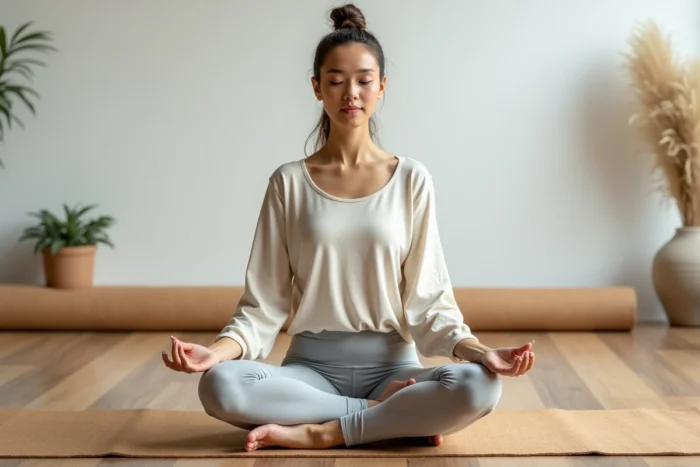
Yin yoga is based on a simple mechanical principle: maintaining a posture on the ground for several minutes, with relaxed muscles, to engage the deep connective tissues (fascia, ligaments, joint capsules) rather than the muscle fibers. This prolonged and passive load distinguishes the practice from all dynamic forms of yoga and explains its direct effect on the parasympathetic nervous system, which governs rest and digestion.
Connective tissue and nervous system: why yin yoga promotes relaxation
In a vinyasa or ashtanga class, muscle contraction absorbs the majority of the mechanical stress. The fascia and ligaments are minimally stimulated. Yin yoga reverses this relationship: by removing voluntary effort, the load shifts to the deep tissues.
These tissues respond slowly to stretching. They require duration, not intensity. That’s why each posture is held for several minutes, a threshold that allows for the plastic deformation of the fascia and promotes better hydration of the joints.
The other mechanism is neurological. Prolonged immobility, combined with slow breathing, shifts the autonomic nervous system into the parasympathetic mode. Heart rate slows, blood pressure decreases, and cortisol production drops. To delve deeper into the postures of yin yoga on MS Médical, each position is described with its variations and anatomical targets.
Yin yoga postures for the hips and pelvis
The hips hold a significant amount of tension accumulated from sitting. Two postures specifically target this area with particular effectiveness.
The butterfly (Baddha Konasana yin)
Sitting on the ground, soles of the feet together, knees open outward, the torso gently leans forward. The adductor muscles and the groin fascia gradually relax under the effect of gravity. A cushion under each knee reduces tension if hip opening is limited.
The swan (yin variant of pigeon)
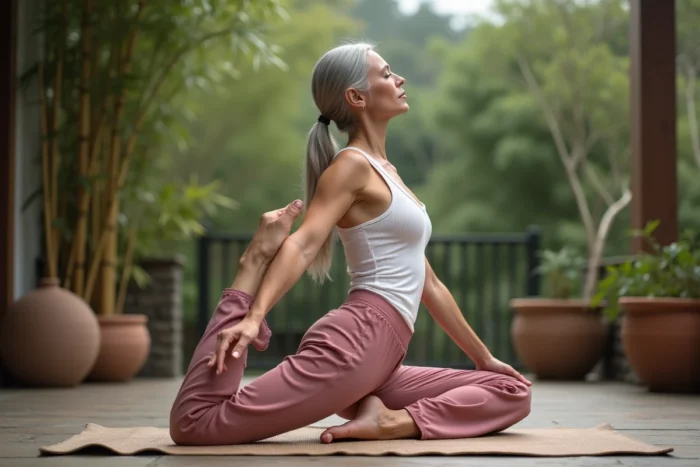
One leg bent in front, the other extended behind, the torso descends toward the ground. This posture targets the external rotators of the front hip and the flexors of the back hip. The challenge lies in the pelvis: if it tilts to one side, a support under the buttock on the bent side corrects alignment and protects the knee.
Yin yoga postures for the spine
The thoracic spine and lumbar region accumulate stiffness that quick stretches do not resolve. Two yin postures address them precisely.
The sphinx and the seal
Lying on the stomach, forearms on the ground (sphinx) or arms extended (seal), the lumbar lordosis passively increases. This gentle extension decompresses the anterior intervertebral discs. The sphinx is suitable for beginners, while the seal increases the range for more flexible practitioners.
The supine twist (Supta Matsyendrasana)
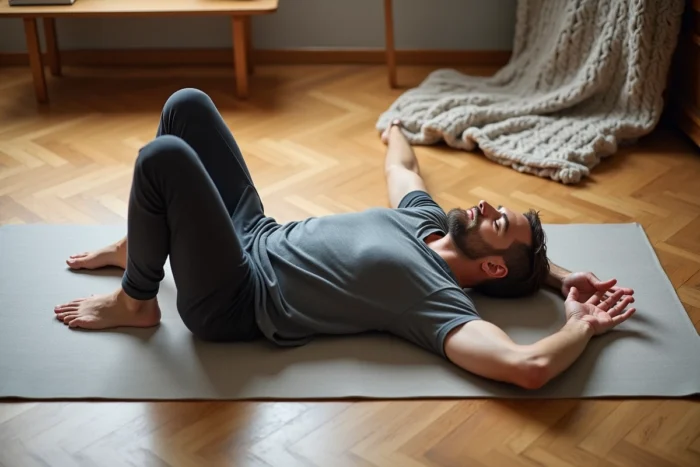
On the back, one knee crossed over the body, arms open. The rotation affects the oblique muscles, the quadratus lumborum, and the thoracolumbar fascia. One precaution to remember: supine twists should be practiced cautiously in case of intervertebral disc issues, or even after medical advice. This point is rarely mentioned in relaxation guides, but it conditions the safety of the posture.
Viparita Karani: the yin posture that prepares for sleep
Legs raised against a wall, pelvis on the ground or on a support, this gentle inversion produces measurable effects on recovery. Venous return improves, heart rate slows, and pressure in the lower limbs decreases.
Yin yoga sequences designed for the evening place Viparita Karani as the central posture, with recommended durations of seven to ten minutes. This posture is described as the most effective in the routine for sleep quality.
To set it up correctly:
- The pelvis should be a few centimeters from the wall, not touching, to respect the natural lumbar curvature.
- A thin cushion under the hips relieves the sacroiliac area and allows for longer holds without discomfort.
- The arms rest along the body or on the belly, palms facing up, to relax the shoulders and chest.
Building a coherent yin yoga session for relaxation
Linking postures without logic reduces their effect. The order is as important as the choice of positions.
- Start with a neutral posture (the caterpillar, seated forward bend) to calm the nervous system and establish the breathing rhythm.
- Place the hip openers (butterfly, swan) in the middle of the session, when the tissues are already warmed up from the first minutes of immobility.
- Finish with Viparita Karani or a supine twist, postures that amplify parasympathetic activation just before final rest.
Breathing remains the guiding thread. A longer exhalation than inhalation (for example, four counts of inhalation, six of exhalation) reinforces the shift into rest mode. This ratio does not need to be rigid: the natural lengthening of the breath over the minutes is sufficient.
Each posture gains depth with duration, not with force. Pulling on a fascia to go further does not produce relaxation but a muscle protection response that blocks stretching. Gravity and time do the work. The role of the practitioner is limited to staying still, breathing, and observing sensations without correcting them.