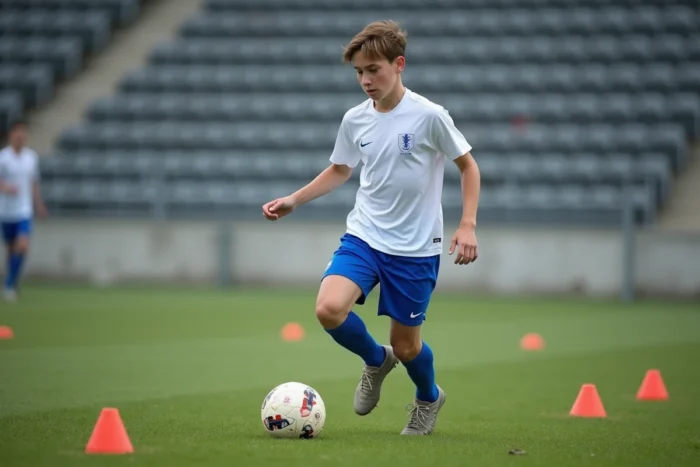
How many young licensed players in amateur clubs end up signing a professional contract in France? The proportion is tiny, and the journey from a neighborhood pitch to a locker room in Ligue 1 or Ligue 2 follows a precise timeline, with age windows that do not forgive delays. This article measures the actual stages of the French football pathway, their durations, and the conversion rates at each level to become a professional football player.
Age windows and conversion rates in the football pathway in France
The training of professional football players in France follows a sequence of stages, each of which eliminates a large portion of candidates. The table below summarizes the structuring steps and the associated ages, as they emerge from the federal framework.
| Stage | Indicative Age | Structure | Note |
|---|---|---|---|
| License in amateur club | 5-11 years | Neighborhood or community club | First observation by local educators |
| District/league detection | 12-13 years | FFF detection days | First federal filter, spotting by recruiters |
| Hope center or pre-training | 13-15 years | Sports section, sports-study | Mandatory educational support |
| Approved training center | 15-18 years | Professional club (L1, L2, National) | Individualized protocol supervised by the FFF and the Ministry of Sports |
| Signing or exit | 18-19 years | Pro contract or reclassification N3/R1 | Last structured window of the elite pathway |
What stands out is the brevity of each window. A young player spotted at 12 years old has two to three seasons to confirm before entering a training center. Those who wish to play football with France Sports find a comprehensive overview of the pathways available from the early years of practice.
Detection and recruitment in clubs: what happens before the training center
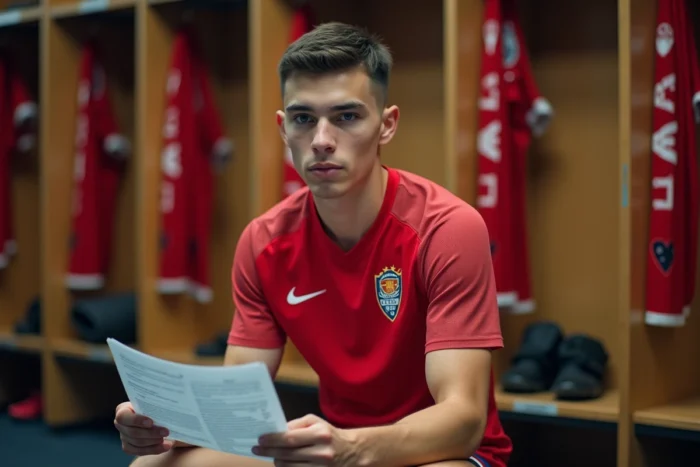
Most content on the subject presents detection as a unique moment. In practice, detection operates in a continuous loop over several seasons. Recruiters from professional clubs attend matches in departmental and regional championships, as well as events organized by districts and regional leagues.
A player who plays in an amateur club at 12 or 13 years old is observed based on technical criteria (passing quality, game reading) and physical criteria (speed, coordination). However, physical maturity at this age varies greatly from one teenager to another, prompting some centers to reassess profiles that were dismissed one or two years earlier.
Passing through a Hope center often serves as an intermediate step. These structures, linked to regional leagues, allow for a combination of higher-level training with schooling. About 30% of the 2018 World Cup champions passed through a Hope center, according to the French Football Federation. This figure illustrates the significance of this stage in the journey toward the professional level.
Approved training center: the main filter of French football
The training centers approved by the FFF welcome young players between 15 and 18-19 years old. Their operation is governed by a protocol that imposes mandatory educational and academic support for each player. The dual project (sport and studies) is not optional: it conditions the approval of the center.
On the field, daily training structures progression. Young trainees train with the reserve team or the U19 section of the club, participate in national championships in their category, and are regularly evaluated by the technical staff. The center’s coach and the training director establish an individual assessment each season.
Evaluation criteria in training centers
- Technical progression measured over the season: quality of control, decision-making under pressure, ability to play with both feet
- Physical data monitored by the medical staff: injury resistance, growth, recovery capacity after matches
- Behavior off the field: school attendance, respect for the collective framework, stress management in competition
- Tactical versatility: ability to occupy multiple positions, understanding of the first team’s game systems
The level of demand varies from club to club. The centers ranked highest by the FFF (often those in Ligue 1) have more comprehensive facilities, but competition is also fiercer there. The majority of young trainees never sign a professional contract with their training club.
The last window: managing the exit from the training center at 18-19 years
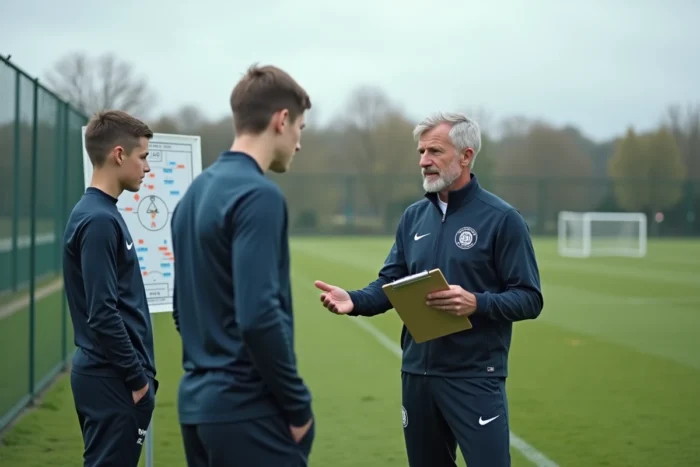
Competitors rarely address this pivotal moment. At 18 or 19 years old, the player at the end of their cycle in the training center faces three scenarios.
The first: the club offers a professional contract. This is the case for a minority of each cohort. The player then joins the first team or is loaned to a lower division club to gain competitive playing time.
The second: no contract is offered, but the player maintains a sufficient level to play in National 2, National 3, or Regional 1. This reclassification in lower divisions represents the reality for most graduates. It does not mean the end of the journey: players like Éric Carrière never joined a training center before being recruited in lower divisions and then climbing the ranks.
The third: retraining. The dual educational project then makes complete sense, as it offers a diploma or training that allows for a rebound outside the field.
Transversal skills to develop in parallel
- Following an academic or university curriculum (some players from the 2026 France team hold diplomas beyond the baccalaureate)
- Understanding the legal framework of the professional contract: duration, clauses, rights of locally trained players
- Building a network with recruiters, agents, and coaches met during youth competitions
The French professional football pathway operates like a funnel, with each stage drastically reducing the number of candidates. The journey does not end at the exit from the training center: for many, the period between 18 and 22 years, spent between National 3 and Ligue 2, constitutes the true test of endurance before a potential sustainable career at the professional level.