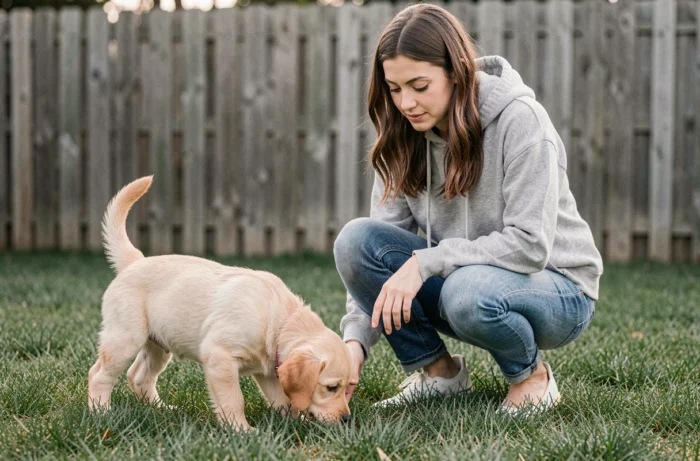
At two months, a puppy cannot yet control its bladder. The bladder is the last organ to reach maturity in dogs, which explains the frequent and unpredictable eliminations at this age. Teaching a 2-month-old puppy to be clean relies less on prohibitions and more on a structured routine of outings and rewards tailored to the physiological functioning of the young animal.
Bladder control in a 2-month-old puppy: what physiology dictates
A two-month-old puppy cannot hold it for long between eliminations. Its urinary system is still immature, and no educational method will change this biological fact. Expecting such a young animal to signal its need to go out is a misunderstanding of its actual capabilities.
The elimination rhythm depends on several factors: breed size, amount of water ingested, activity level, and stress. A puppy that plays intensely or has just woken up will need to go out within minutes. Ignoring these physiological windows leads to accidents that slow down the learning process.
Protocols based exclusively on positive reinforcement (immediate reward after elimination in the right place, predictable routine) allow for a significantly faster acquisition of cleanliness than mixed or punitive approaches, with timelines shortened by several weeks. Recent studies published in the Journal of Applied Animal Welfare Science confirm this gap. A detailed guide is available on the britishandco.com website to structure this method in daily life.
Frequency of outings for a 2-month-old puppy: a realistic schedule
Most guides recommend taking the puppy out “often,” without specifying what that means in practice. At two months, the useful frequency is well beyond what many owners anticipate.
The moments for going out are non-negotiable. Here are the windows to systematically cover:
- Immediately after each awakening, including short daytime naps, as the transition from wakefulness to sleep almost automatically triggers the need to eliminate.
- Within five to ten minutes after a meal or drinking water. The gastrocolic reflex is particularly active in young puppies.
- After every play or excitement session, even brief ones. Physical activity speeds up transit and stimulates the bladder.
- Just before settling down for the night, and at least once in the middle of the night during the first weeks.
Taking the puppy out every one to two hours during the day is not excessive at this age. This sustained rhythm lasts only a few weeks, until bladder capacity increases. Reducing the frequency too early multiplies indoor failures and muddles the educational message.
Rewarding after outdoor elimination: timing makes all the difference
The reward works, but its effectiveness depends on a parameter that many owners underestimate: the delay between elimination and reward should be a few seconds. Waiting until you are back home to give a treat creates no association in the puppy’s mind.
Specifically, the sequence is as follows: the puppy eliminates outside, you reward it on the spot with a treat, an upbeat voice, or a game. Repeating this sequence day after day builds the puppy’s motivation to eliminate outside rather than inside.
On the other hand, scolding a puppy after an accident does not speed up the learning of cleanliness. Even if caught in the act, punishment generates stress without the animal being able to connect the sanction to the behavior. Field reports vary on this point among owners, but behavioral data are consistent: punitive methods slow down the acquisition of cleanliness.
The trap of newspapers or scented pads
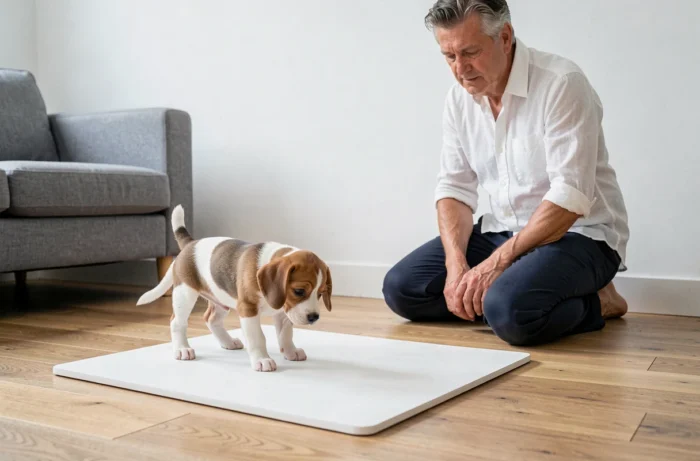
Using newspaper or absorbent pads as an intermediate step seems logical, but it creates a concrete problem: the puppy learns to eliminate indoors on a dedicated surface. When you remove this surface, it must unlearn a behavior before acquiring another. Starting directly with the outdoors, even if accidents are more frequent at first, shortens the overall learning duration.
Cage and resting space: a tool often misused for puppy cleanliness
The crate (or transport box) is often presented as a cleanliness accelerator. The principle is based on a natural behavior: a puppy avoids eliminating where it sleeps. Limiting its resting space encourages it to hold it and signal its discomfort.
Recent guides from animal protection organizations recommend placing the crate in a living area (living room, kitchen, bedroom at night) rather than in an isolated space. Isolation increases the puppy’s stress, which speeds up transit and causes exactly the opposite of the desired effect.
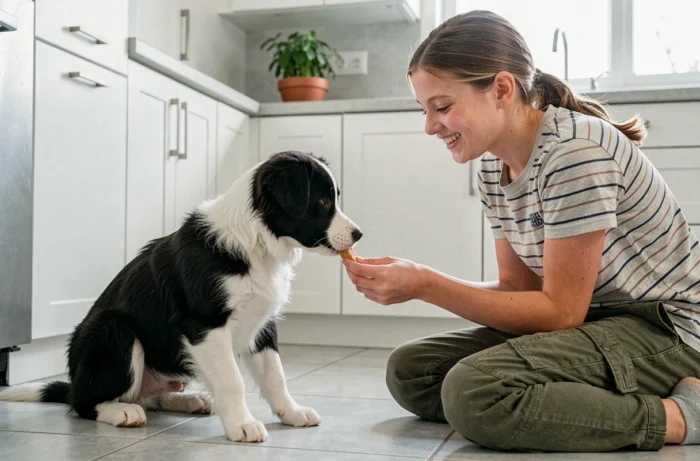
A rarely addressed point: crate anxiety and separation anxiety are two distinct problems that require different responses. A puppy that cries in its crate does not necessarily have a separation issue. It may simply not have been gradually accustomed to confinement. The recommended progression starts with a few minutes, door open, with a treat inside, and then gradually extends over several days.
When the crate becomes counterproductive
If a puppy regularly eliminates in its crate despite frequent outings, the crate is probably too large or the confinement durations too long. An appropriately sized crate leaves just enough room for the puppy to lie down and turn around. Excessive space allows the puppy to create a “toilet zone” in a corner, which nullifies the effect of confinement on retention.
Nighttime cleanliness: a progression distinct from daytime
Nighttime cleanliness is acquired later than daytime cleanliness. Metabolism slows during sleep, but a two-month-old puppy’s bladder capacity remains limited. Withholding water several hours before bedtime helps to some extent, provided the puppy has had access to enough water during the day.
Scheduling a nighttime outing, at least during the first few weeks, prevents accidents and reinforces the message. A wake-up in the middle of the night is better than cleaning up every morning: the puppy that successfully makes it through the night without an accident progresses faster than one that was wallowing in its eliminations until morning.
The majority of puppies achieve reliable cleanliness around six months. Some succeed earlier, others later, depending on breed and training conditions. Setting a goal of complete cleanliness at two or three months is unrealistic and generates unnecessary frustration for the owner, who ends up doubting their method while the puppy is simply following its biological rhythm.