
The automotive technical review (RTA) remains the reference document for anyone wishing to work on their vehicle without relying on a garage. Each booklet covers a specific model, including disassembly procedures, torque specifications, electrical diagrams, and maintenance intervals recommended by the manufacturer. Accessing these manuals requires knowing where to look, and the shift to digital has reshuffled the deck among historical publishers, online platforms, and community resources.
Exploitation rights of digital RTAs: a stricter legal framework since 2024
The proliferation of platforms offering dematerialized RTAs raises a question rarely addressed by competing sites: that of the legality of the digital distribution of this content. French case law from 2023-2024 in copyright has tightened the formalism of rights transfer agreements. Each mode of distribution (paper, PDF, online platform, mobile application) must now be explicitly and distinctly provided for in the transfer contract.
For a database of automotive technical review books, this concretely means that distributing or sharing digitized RTAs without explicit clauses exposes the operator to a real legal risk. A garage sharing PDF files of RTAs on an internal network, or a platform scanning paper editions to resell online, could find itself in a situation of infringement if the original contract did not cover this mode of exploitation.
This tightening clearly distinguishes the ownership of the physical medium (the book you buy) from the ownership of copyright on its content. Owning a paper copy of an RTA does not confer any reproduction or online publication rights.
Paper RTA, PDF, or interactive platform: what each format brings to car maintenance
Technical auto publishers today offer several formats for accessing technical reviews. Consulting a database of automotive technical review books allows for comparing these options before committing.
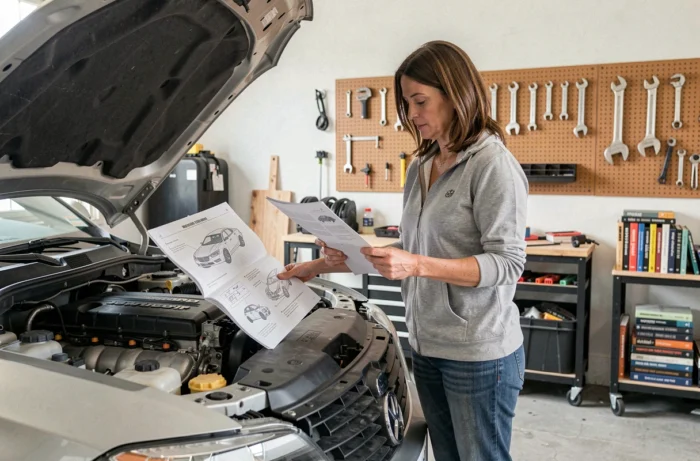
The paper format remains popular in workshops: it is resistant to grease and connection outages. However, it quickly becomes outdated if the manufacturer publishes technical updates after the booklet’s release.
PDF versions replicate the paper content exactly, with the advantage of keyword search. Their limitation lies in their static nature: no updates are pushed after purchase.
Next-generation interactive platforms integrate features absent from the first two formats:
- VIN number search, which automatically associates documentation with the exact vehicle model (engine type, year, variant)
- Videos integrated into disassembly procedures, useful for visualizing a technical gesture described in text
- Continuous updates reflecting corrections and recalls published by manufacturers after the model’s release
The additional cost of a subscription to an interactive platform compared to purchasing a paper booklet is particularly justified for motorists who work on multiple vehicles or keep their car for a long time. For a one-time operation (brake pad replacement, oil change), a simple PDF is sufficient.
Reliability of technical content: official RTA versus community resources
Forums and community sites like TECHNIrevue offer practical sheets and tutorials written by enthusiasts. These resources sometimes cover models for which no RTA has been published, or very specific operations (adapting an accessory, resolving a recurring defect in a series).
The fundamental difference with an official RTA lies in the validation of technical data. An RTA booklet published by ETAI (Editions Techniques pour l’Automobile et l’Industrie) is constructed from manufacturer documentation. Torque specifications, fluid capacities, and adjustment tolerances are verified.
On a forum, a contributor may share a procedure that worked on their vehicle without the values being cross-checked. For routine operations (oil filter change, accessory belt replacement), the reliability gap is small. For interventions affecting braking, steering, or the cooling system, using unverified values can compromise vehicle safety.
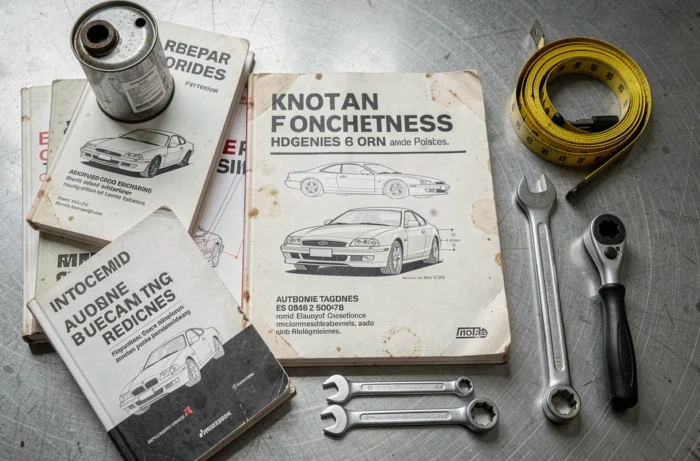
Field feedback varies on this point: some amateur mechanics find community sheets clearer than official RTAs, whose technical writing can deter a non-professional. Others report errors in torque specifications or missing steps in unreviewed tutorials.
Choosing the right technical review according to your vehicle and level
Not all RTAs are created equal, and the choice depends as much on the model as on the reader’s experience. A few criteria can help select the appropriate documentation:
- Engine coverage: an RTA may exist for a given model (Renault Clio, Peugeot 308) but only cover part of the engine types. Check that the specific diesel or gasoline version is adequately addressed before purchasing
- Level of detail in electrical diagrams: on recent vehicles loaded with electronics, an incomplete diagram makes diagnosis nearly impossible without an OBD reading tool
- Publication date: an RTA published in the year of the model’s commercialization does not take into account manufacturer recalls or technical notes published later
- Language and units: Haynes manuals, of Anglo-Saxon origin, sometimes use imperial units or references to tools that are uncommon in France
For vehicles over twenty years old, finding an RTA can be akin to a treasure hunt. Some models have never had a dedicated booklet. Specialized sites for old documentation and owner groups remain the best leads.
The automotive technical review retains its usefulness as long as one knows its limits. It does not replace electronic diagnostics on a modern vehicle, nor the experience of a professional for heavy operations. However, it provides a solid documentary foundation for routine maintenance, understanding mechanical operation, and autonomy in the face of simple breakdowns.