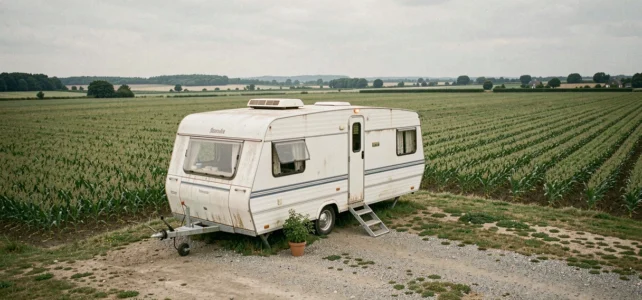
The parking of a caravan on rented agricultural land is not subject to the same regulations as installation on a conventional private property. The distinction between temporary parking and permanent installation conditions the entire legal analysis, and the status of tenant (as opposed to that of operator) adds a layer of constraint that most articles overlook.
Temporary parking and permanent installation on agricultural land: two distinct regimes
The Urban Planning Code clearly distinguishes between the parking of a caravan, defined as its immobilization for a duration of less than three months per year, and its permanent installation. For less than three months, no urban planning authorization is required, provided that the caravan retains its means of mobility (wheels, axles) and is not connected to any network.
Beyond three consecutive months, Article R. 111-47 of the Urban Planning Code qualifies this presence as installation. A prior declaration then becomes mandatory, and the regulations of Zone A of the PLU apply. The problem: in agricultural zones, the regulations almost exclusively permit constructions and installations necessary for agricultural operations.
The question of whether one can keep a caravan year-round on agricultural land thus confronts this destination restriction head-on. The PLU does not govern the simple parking of a caravan, as administrative jurisprudence has reminded us, but once the three-month threshold is crossed, the urban planning document reasserts its rights.
Tenant of agricultural land: an unfavorable legal status
Being a tenant of the land, rather than an owner-operator, further reduces the room for maneuver. The rural lease (farming or sharecropping) frames the use of the rented land and limits it to its agricultural purpose. Installing a caravan permanently for habitation does not constitute an agricultural use of the land.
The tenant cannot invoke the necessity of operation to justify permanent habitation, unless they are themselves a declared agricultural operator and the presence on site is related to the conduct of the operation (monitoring livestock, nighttime irrigation, etc.). This justification is still assessed on a case-by-case basis by the urban planning authority.
The owner-landlord also incurs liability. If the mayor detects an infraction, the report targets the land and may lead to criminal proceedings against both the occupant and the owner who tolerated the installation.
Sanctions and powers of the mayor in agricultural zones
The mayor has several levers to put an end to an irregular installation. In practice, we observe a fairly predictable escalation:
- A registered letter of formal notice, setting a deadline for the removal of the caravan and any ancillary installations (dry toilets, connections, terrace).
- A report of infraction to the Urban Planning Code, sent to the public prosecutor, which may lead to criminal proceedings with fines and a requirement to restore the site.
- An emergency action before the judicial court if the occupant does not comply, allowing the judge to order removal under penalty.
Fines for unauthorized installation can reach several thousand euros, and the court may order the restoration of the land at the expense of the offender. The statute of limitations for public action in urban planning matters runs from the completion of the works or installation, which gives the administration a significant window for intervention.
Law of May 26, 2026: an opening for operators, not for tenants
Law No. 2026-403 on the simplification of economic life has amended Article L151-12 of the Urban Planning Code. It now provides for the possibility of implanting a demountable residence constituting the permanent habitat of the agricultural operator, linked to the headquarters of the operation and subject to the condition of necessity for the activity.
This evolution could, in the long term, regulate light housing (yurt, tiny house, immobilized caravan) on agricultural land. The implementing decree has not yet been published, which keeps the previous law in effect.
We recommend not to anticipate this reform. As long as the decree has not been issued, no demountable residence can claim this new framework. And even once applicable, the text targets the agricultural operator holding the headquarters of the operation, not a third-party tenant of the plot.
Legal alternatives for residing on rented agricultural land
If the goal is to reside on agricultural land without being an operator, the options remain very limited. The most realistic option is to obtain a partial change of destination of the plot through a revision or modification of the PLU, a lengthy procedure that depends on the political will of the municipality.
The Pastilles, provided for by the ALUR law, allow municipalities to delineate in the PLU sectors of limited size and capacity (STECAL) where light housing may be authorized, even in Zone A or N. In practice, very few municipalities have activated this mechanism.
- Check if the municipality’s PLU contains a STECAL allowing light housing in agricultural zones.
- Ask the owner-landlord if they agree to submit a request for modification of the PLU to the town hall.
- Consider a rural lease with a housing clause if one obtains the status of agricultural operator (installation via the chamber of agriculture).
- Prefer a plot classified as buildable or recreational land for legal permanent parking.
The installation of a caravan year-round on rented agricultural land remains, under the current law, an infraction in almost all configurations. The only variable that could modify this analysis is the publication of the implementing decree of the May 2026 law, the scope of which will still be limited to agricultural operators themselves.