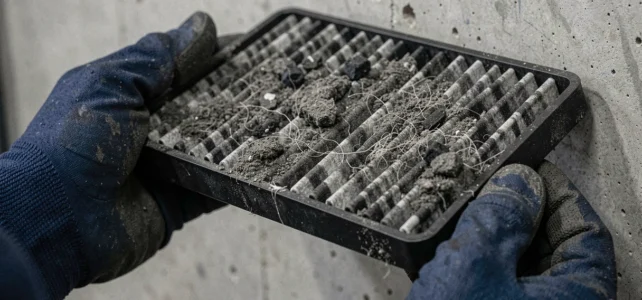
We open the air filter housing during a routine oil change, and the observation is clear: the once-clear surface has turned dark gray, even black. This darkening of the air filter indicates an accumulation of particles that the engine has sucked in over thousands of kilometers. Understanding what causes this saturation and knowing when to intervene helps avoid a cascade of problems with the engine, the turbo, and fuel consumption.
Damage to the turbo and mass airflow sensor: what a saturated air filter causes downstream
Most drivers associate a clogged filter with a simple loss of power. The problem lies further down the intake chain.
When the filter structure is clogged, the engine sucks harder to compensate for the lack of airflow. This abnormal vacuum puts stress on the turbocharger beyond its normal operating range. The fine particles that pass through a degraded filter also abrade the turbo blades and clog the mass airflow sensor. The mass airflow sensor then transmits distorted values to the engine control unit, disrupting the injection dosage.
On a diesel engine, this combination often results in black smoke during acceleration. One might think of an injector or EGR valve problem, while the root cause is simply an air filter that has been forgotten. Understanding why the air filter is black helps make the right diagnosis before replacing expensive parts.
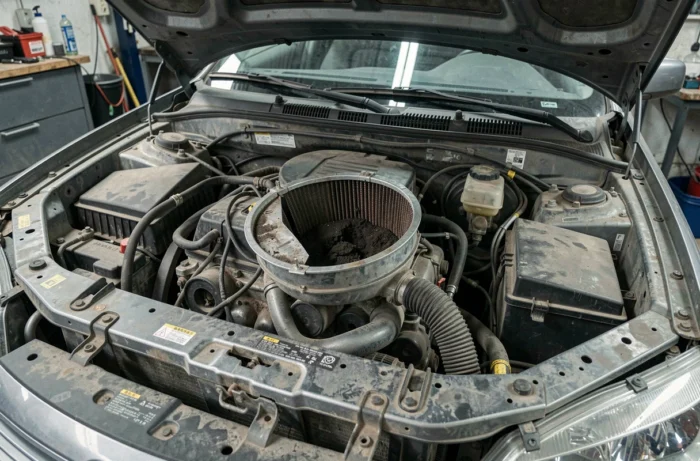
Black air filter: factors that accelerate clogging
All filters darken over time, but the speed varies significantly depending on vehicle usage. Three determining factors can be distinguished.
Urban driving and dusty areas
In the city, the engine often runs at low RPM in air laden with brake particles, tire residues, and construction dust. A vehicle that primarily drives in urban areas saturates its filter much faster than a highway vehicle. Short trips also prevent the engine from reaching its optimal temperature, promoting greasy deposits on the filtering media.
Soot and engine oil blow-by
A black and greasy filter, rather than simply gray from dust, often indicates oil blow-by through the breather circuit. This phenomenon affects high-mileage engines with worn piston rings. The soot produced by combustion, especially in diesels, also contributes to uniformly coloring the filter.
Too long replacement intervals
Manufacturer intervals of 15,000 to 30,000 km are not suitable for all uses. In urban driving or very dusty areas, a visual inspection every 10,000 km is recommended. Sticking to the maintenance manual’s recommendations without considering actual conditions means allowing the filter to gradually clog to the point of no return.
Cleaning a clogged air filter: method according to filter type
Not all filters can be cleaned the same way, and some should not be cleaned at all.
Paper or cardboard filter: replacement rather than cleaning
Dry paper filters make up the majority of original filters. It is often said that a blast of compressed air is enough to revive them. This is a documented technical error: blowing a paper filter with compressed air tears the microscopic structure of the fibers. The filter may appear cleaner visually, but its filtration capacity drops. Particles then pass directly to the turbo and the mass airflow sensor.
Washing with water poses the same problem: the fibers swell, deform, and never regain their original porosity. For a clogged paper filter, replacement remains the only reliable option. The cost of a new filter is modest compared to that of a damaged turbo or mass airflow sensor.
Reusable foam filter: true cleaning is possible
Foam or oiled cotton filters (sport type) are designed to be maintained. Here’s the procedure that works:
- Remove the filter from the housing and gently tap to eliminate the largest particles, without rubbing the surface
- Apply a specific sport filter cleaner, let it act according to the manufacturer’s instructions, then rinse with lukewarm water at low pressure from the clean side to the dirty side
- Let it dry completely in the open air (never with a hairdryer or in direct sunlight), then re-oil with the appropriate product before reinstalling the filter
A poorly re-oiled foam filter filters less effectively than a new paper filter. The oiling step is often rushed, which negates all the benefits of cleaning.

Concrete signs that you need to intervene on your car’s air filter
Rather than relying solely on mileage, it’s beneficial to identify on-the-ground symptoms. Some signals are unmistakable:
- A notable increase in fuel consumption without a change in driving habits, linked to an unbalanced air-fuel mixture
- A lack of responsiveness during acceleration, especially noticeable when climbing or during overtaking on the highway
- A check engine light on associated with a fault code related to the mass airflow sensor or mixture richness
- Black or gray smoke from the exhaust on a diesel engine, particularly when cold or during hard accelerations
Feedback varies on this point, but on some recent vehicles, the engine control unit compensates for the lack of air for so long that the symptoms remain discreet until the filter is truly clogged. Regular visual checks are more reliable than waiting for a blatant symptom.
Your car’s air filter costs a few dozen euros and can be replaced in a few minutes without specific tools. Delaying its maintenance exposes the turbo, mass airflow sensor, and injectors to premature wear, with costs running into the hundreds of euros.
Open the housing every 10,000 km in urban driving, replace a blackened paper filter rather than trying to save it, and follow the re-oiling protocol on a reusable filter: these three reflexes are enough to protect the engine’s intake over time.