
The Interrail pass covers the rail network of over thirty European countries, but it does not include long-distance coaches. FlixBus operates on a completely different pricing and logistical model, with its own tickets and routes. The two tools do not replace each other, and it is precisely in their combination that the interest lies for a traveler crossing Europe over several weeks.
FlixBus and Interrail: two networks that do not overlap
A common misconception is that the Interrail pass provides access to all European land transport. The pass covers trains from participating rail companies, not bus lines. FlixBus requires a separate ticket, purchased independently of the pass.
This separation has a direct consequence on itinerary planning. Each FlixBus trip does not consume an Interrail travel day. For holders of a limited-day pass (five days in one month, for example), inserting a bus trip between two rail segments allows for the preservation of train days for higher-value connections.
Before booking, it is useful to understand how to use FlixBus with an Interrail pass to properly balance between the two modes of transport.
However, this combination requires a minimum of organization. FlixBus schedules and train connections are not synchronized. An arrival by bus at 11 PM at a remote bus station, followed by an early train departure the next day from the central station, can turn a savings into a source of logistical stress.
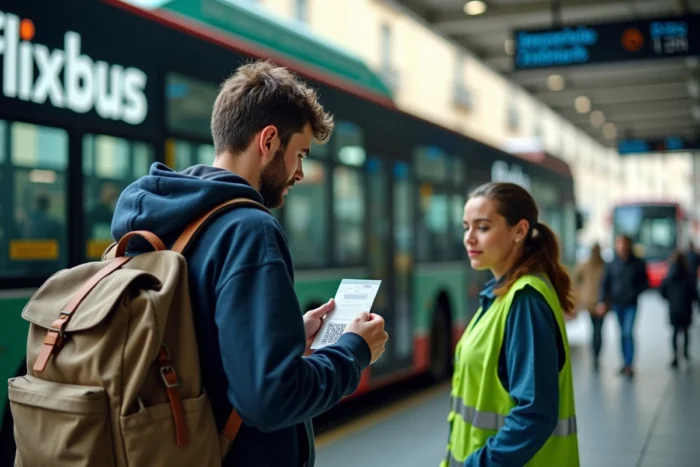
Relevant bus trips when rail is less competitive
The Interrail pass shines on corridors well served by high-speed rail or night trains: Paris-Amsterdam, Vienna-Munich, Stockholm-Copenhagen. On these routes, the train is fast, frequent, and the pass absorbs the ticket cost.
The situation changes in regions where the rail network is less dense or slower. The Balkans, part of Central Europe, and certain mountain crossings are areas where FlixBus often offers a better time-price ratio than regional trains. A journey between two Balkan capitals by rail may involve multiple connections, recurring delays, and a total duration that far exceeds that of a direct bus.
Corridors where the bus has the advantage
- Connections between Balkan capitals (Sofia, Skopje, Tirana, Belgrade) where trains are rare or slow, and where FlixBus offers regular direct services
- Crossings through mountainous areas (Eastern Alps, Carpathians) where rail lines take long detours and multiply stops
- Connections between medium-sized cities not linked by rail, common in Eastern Europe, where FlixBus fills a gap in transport offerings
On these segments, using an Interrail pass day for a slow train represents a poor calculation. The bus often costs less than a mandatory train reservation, and the travel time can be equivalent or shorter.
FlixBus Booking: the schedule changes the price
FlixBus applies dynamic pricing. The price of the same trip varies according to the booking date, the day of the week, and the bus’s occupancy rate. Booking several weeks in advance significantly reduces the fare, sometimes by half compared to a purchase the day before departure.
Departures mid-week (Tuesday, Wednesday) and outside peak periods generally show the lowest prices. For an Interrail traveler whose itinerary remains flexible, scheduling bus segments during these slots helps keep the overall transport budget at a reasonable level.
Compare before booking a bus trip
FlixBus is not the only long-distance bus operator in Europe. On certain routes, local companies or platforms like BlaBlaCar Bus offer comparable or lower fares. Checking multiple operators on the same route before purchasing is a reflex that makes a difference, especially on heavily trafficked corridors (France-Spain, Germany-Poland).
The FlixBus app allows you to track price variations in real-time. Creating alerts for planned trips a few weeks before departure provides good visibility on pricing trends and the optimal time to buy.

Building a mixed train-bus itinerary in Europe
The combination of Interrail and FlixBus works best when planned in advance. The basic principle: book the Interrail pass for high-value rail lines, and the bus for segments where rail is absent or underperforming.
An example of itinerary logic: use the pass to connect Paris to Munich by TGV and then German train, switch to FlixBus between Munich and Zagreb (long rail connection with transfers), then take the train between Zagreb and Vienna on a well-timed direct line. This type of segmentation avoids wasting pass days on trips where the train offers neither time savings nor superior comfort.
Logistical points to watch
FlixBus bus stations are not always located near train stations. In some cities, the transfer between the two can take time, especially using local public transport. Checking the exact location of the FlixBus stop before planning a tight connection avoids unpleasant surprises.
Bus delays are less predictable than train delays, especially on long international trips subject to border controls. Allowing a margin of at least two hours between a bus arrival and a scheduled train departure with the pass limits the risk of missing a connection.
The Interrail pass and FlixBus serve different needs on the same trip. Treating them as two complementary tools, rather than alternatives, allows for covering more European territory without blowing the budget or sacrificing the flexibility that makes a tour of Europe appealing.