
The declared living area for tax purposes directly influences the amount of property tax and housing tax on secondary residences. An error of a few square meters, either way, alters the cadastral rental value of the property and thus the final tax bill. Understanding what is included in the calculation, what is excluded, and how to correct erroneous data helps avoid both overpayment and reassessment.
Living area and taxable area: the discrepancies that change property tax
The most common confusion concerns the difference between the living area as defined by construction (article R.111-2 of the Construction Code) and the weighted area used by the tax administration to establish the cadastral rental value. These two measurements do not fully overlap.
| Element | Living area (Construction Code) | Area considered by tax authorities |
|---|---|---|
| Main rooms (living room, bedrooms) | Yes | Yes, with weighting coefficient |
| Kitchen, bathroom | Yes | Yes |
| Converted attics (height over 1.80 m) | Yes | Yes |
| Unconverted attics | No | No |
| Garage, cellar, attic | No | Counted as dependencies |
| Walls, partitions, stairs | Deducted | Deducted |
| Unheated veranda | No | Variable depending on declared use |
The tax administration applies corrective coefficients related to the category of the premises, its standing, and its maintenance. A property classified in a higher category will see its rental value increase even with the same area. The cadastral category influences as much as square meters on the final amount.
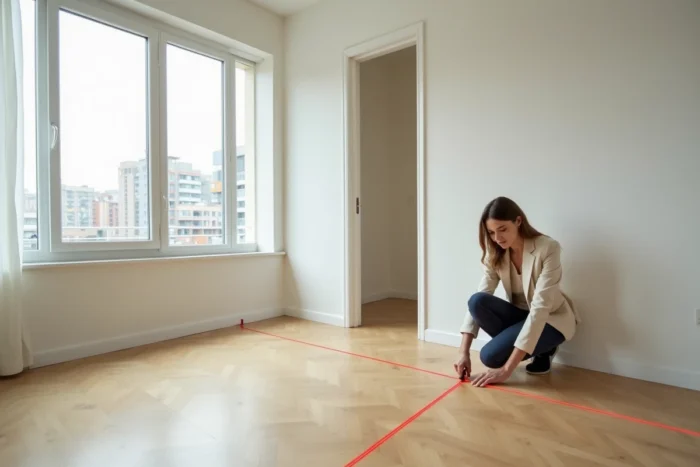
To verify the declared living area for tax purposes, one must compare the description displayed in the online service “Manage my real estate” with an actual measurement of the housing, room by room.
Calculating living area: what ceiling height excludes
The criterion of minimum ceiling height of 1.80 m is the main filter. Any portion of a room located below this threshold is excluded from the calculation of the living area. In a house with converted attics or a mansard apartment, this rule can significantly reduce the gross floor area.
Also deducted are load-bearing walls, partitions, steps and stairwells, technical ducts, and door and window frames. The living area corresponds to what remains after all these deductions are made.
- Converted attics with a height exceeding 1.80 m are included in the calculation, but an attic simply insulated without fixed access remains a dependency
- A basement, even perfectly converted (office, playroom), is not counted as living area in the strict sense
- A heated veranda connected to the housing can be reclassified as living area by the administration if it meets habitability criteria
- The adjoining garage remains a dependency, even if transformed, as long as no declaration of change of use has been filed
For homeowners with atypical volumes, a measurement by an architect or a surveyor removes any ambiguity. The cost of this service is generally modest compared to the risk of an erroneous declaration over several years.
Correcting the area in the “Manage my real estate” service
Since the generalization of the GMBI (Manage my real estate) online service, the DGFIP directs property owners towards online correction of the characteristics of the premises rather than submitting paper forms to the property tax center. The old H1 (house) and H2 (apartment) forms remain usable, but digital processing has become the norm.
The procedure involves logging onto impots.gouv.fr, accessing the “Real estate” tab, and then reporting an anomaly in the description of the concerned premises. Since 2024, the declaration of occupancy has become event-based: property owners no longer re-declare every year but only report changes in situation before July 1st.
In practice, a modification of living area that leads to a change in the number of rooms or the nature of the premises must be reported within this same timeframe. Owners who have carried out expansion work, converted attics, or transformed a garage must submit a specific declaration within 90 days of the completion of the work.
Consequences of a misdeclared area
An undervalued area exposes one to a tax reassessment with back property tax for several years. The administration can go back to the applicable prescription periods. Conversely, an overvalued area generates an overpayment that the taxpayer can recover by requesting a tax relief, provided they provide proof of measurement.
Correcting an old error can generate a refund for the current year and the previous year. Beyond that, the claim depends on the litigation deadlines provided by the Tax Procedure Book.
Declaration of living area for a rental property
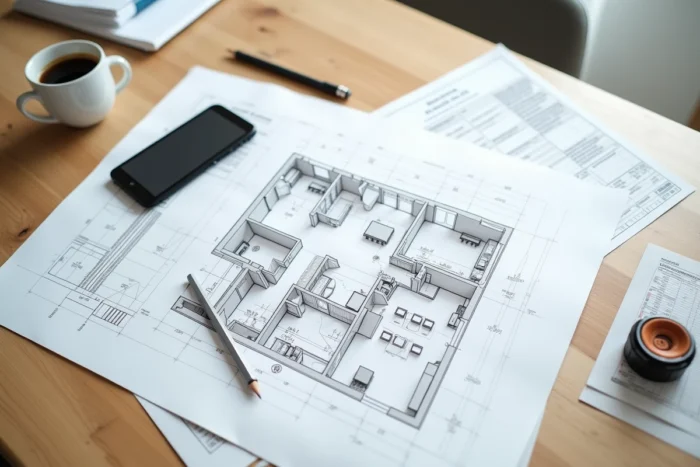
Landlords have an additional obligation: to mention the living area in the lease and declare it to the administration via the GMBI service. This data is used to calculate the housing tax on secondary residences and feeds into the control of rent regulation in tight areas.
For a rented property, the living area stated in the lease must correspond to that declared for tax purposes. A discrepancy between the two documents can pose a problem during a tax audit or a dispute with the tenant. Consistency between the lease and the tax declaration protects the landlord in case of contestation.
- The landlord must ensure that the number of rooms declared in GMBI matches the actual description of the rented housing
- Any structural modification (addition of a room, removal of a load-bearing wall) requires an update of the tax description
- In rent-regulated areas, an erroneous living area can invalidate the applicable reference rent
The living area remains the pivot of local real estate taxation. A reliable measurement, a consistent declaration between the lease and the online GMBI service, and a prompt reporting of any changes are sufficient to secure one’s tax situation without unpleasant surprises.