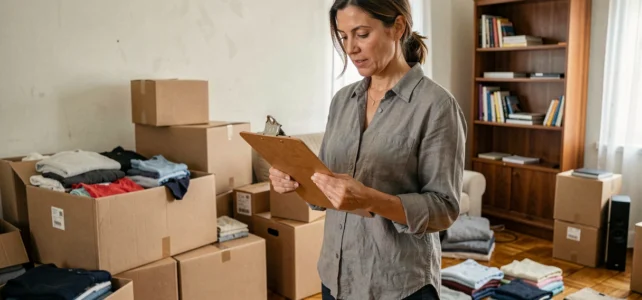
Emptying your house for free first requires understanding where the items go. Each piece of furniture, clothing, or appliance has a possible destination that costs nothing, provided you know the right channels. Sorting is the starting point, but the real savings come from the ability to direct each item to the appropriate outlet: donation, resale, municipal collection, or take-back by an association.
Mandatory sorting of bio-waste and impact on free clearance
Since January 1, 2024, individuals must sort their bio-waste (peelings, food scraps, green waste) separately. This rule changes the game when emptying an entire house. It is no longer possible to throw everything in the household trash as was done before.
In practical terms, during a massive clearance, the Environmental Code imposes a hierarchy: reuse first, recycling next, and disposal as a last resort. Illegal dumping or mixing waste streams can lead to penalties.
Have you noticed that the regular trash bin is increasingly refusing more items? This is the direct consequence of this regulation. To empty your house for free, you must therefore distribute the items among several channels from the start. It takes longer, but it is the only way to avoid both fines and bills from a service provider.
Among the free solutions on By Caroline and CO, several options detail these channels one by one, which helps save time on this distribution step.
Free collection associations to empty your house
Donating remains the most effective lever to get rid of bulky items without paying. However, you need to know who to donate to and under what conditions.
Emmaüs and home collection conditions
Emmaüs offers free home pickup for furniture, appliances, and textiles in good condition. The item must be functional or repairable to be accepted. A stained but structurally intact sofa is acceptable. A collapsed sofa is not.
The collection time varies depending on local branches. Some communities respond within one to two weeks, while others have several weeks of waiting. It’s best to call early, especially during the summer when requests multiply.
Other reuse organizations
Local resource recovery and recycling centers operate on the same principle. They collect items for free that they resell at low prices. Some will pick up furniture at home if the volume justifies it.
- Resource recovery centers often accept a broader range than Emmaüs: dishes, books, gardening tools, toys
- Insertion associations collect computer equipment, even old, to refurbish it
- Thrift stores and Red Cross branches take textiles in good condition, folded and clean
To increase the volume donated, group your items by category before contacting each organization. A single well-prepared call replaces three unnecessary trips.
Reselling items to offset residual costs
Some items have real market value. Reselling them allows you to finance the few unavoidable expenses: renting a van for the dump or buying rubble bags.
Solid wood furniture, recent appliances, and collectible items sell well on peer-to-peer classified ad platforms. Set a realistic price and offer pickup on-site: most buyers are willing to travel if the price is attractive.
Antique dealers and second-hand shop owners will come for free to assess a lot. If the furniture is of interest, they will buy it on the spot and transport it themselves. The price offered will be lower than a sale between individuals, but the time saved is considerable when you need to clear out quickly.
On-site house clearance organized
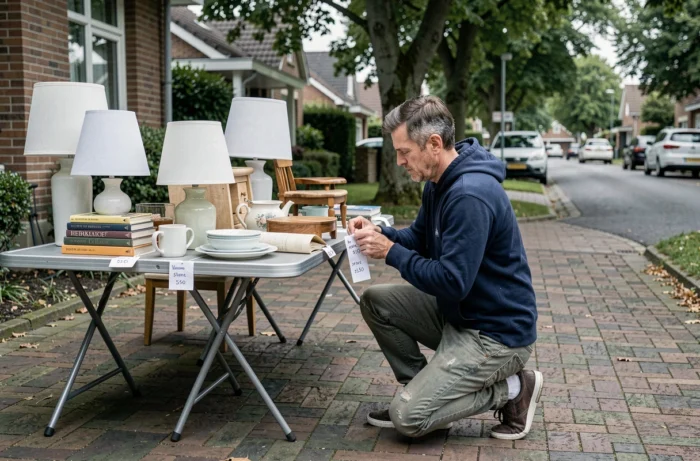
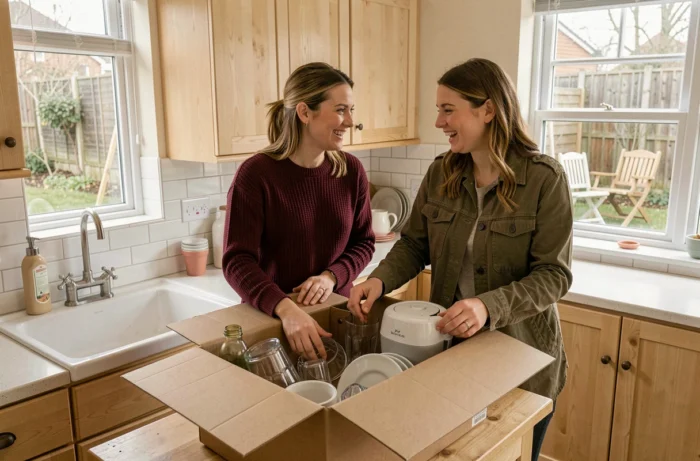
Organizing a house clearance at home remains a free and effective option. The principle: open the house one weekend, display low prices, and let visitors take what interests them.
Be sure to check with your town hall if a prior declaration is necessary. In many municipalities, two garage sales per year are allowed without special formalities for individuals.
Municipal bulky waste collection: what is accepted and what is not
Most local authorities offer free bulky waste collection at home. The service is accessible with a simple call or via the town hall’s website. A few points deserve attention.
- Accepted bulky waste generally includes furniture, mattresses, and large non-functional appliances
- Hazardous waste (paints, solvents, batteries) is refused and must go to the dump
- Waste from electrical and electronic equipment (WEEE) falls under specific channels with free take-back in stores
- The number of annual pickups is often limited, sometimes to two or three collections per household
Plan municipal collection last, after sorting, donations, and resale. What remains at this stage represents a much smaller volume, often compatible with a single visit from the municipal service.
For electrical appliances, the extended producer responsibility scheme guarantees free take-back at a collection point or in-store when purchasing an equivalent appliance. This scheme also applies to solar panels, whose recycling is seeing a significant increase in France.
Emptying your house for free does not require doing everything in one weekend. Spread the process over two to three weeks to allow time for associations to schedule their pickups and for buyers to come forward. A rushed clearance almost always ends up at the dump, with the risk of incurring deposit fees for volumes over quota. Here, free is earned through anticipation.