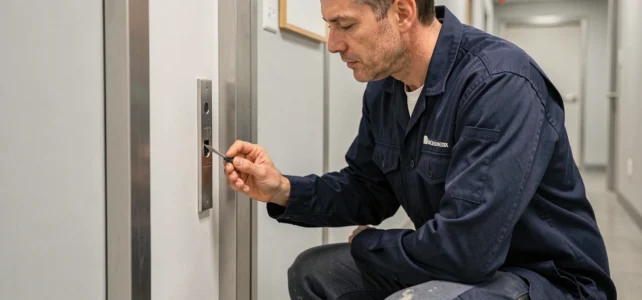
An embedded electric strike that jams or fails to release the latch on the first press almost always indicates a maintenance issue, not a manufacturing defect. The mechanism, subjected to thousands of cycles per year, accumulates dust, metal debris, and micro-alignments that only a rigorous maintenance protocol can manage. Here we detail the technical interventions that preserve the reliability of the device over the long term.
Regulatory constraints related to the maintenance of an embedded electric strike
In a professional environment or an ERP, maintaining an embedded electric strike is not just a matter of common sense. The decree of December 21, 1993, reiterated in the doctrine of the Labor Code, mandates a check at least twice a year of automatic closures, with a frequency adapted to usage and risk level.
Each intervention must be recorded in the safety register. A lack of traceability exposes the operator during an inspection or incident. We recommend formalizing a dedicated sheet for each strike, noting the date, type of check, and the identity of the technician.
When the strike is integrated into a fire door or a compartmentalization device, the NF S 61-937 standard requires operation in positive safety: the door must release upon power failure. Maintenance then includes a periodic test of behavior in case of power loss, which many maintenance plans overlook.
Applying the best practices for your electric strike within this regulatory framework avoids non-compliance and extends the service life of the mechanism.
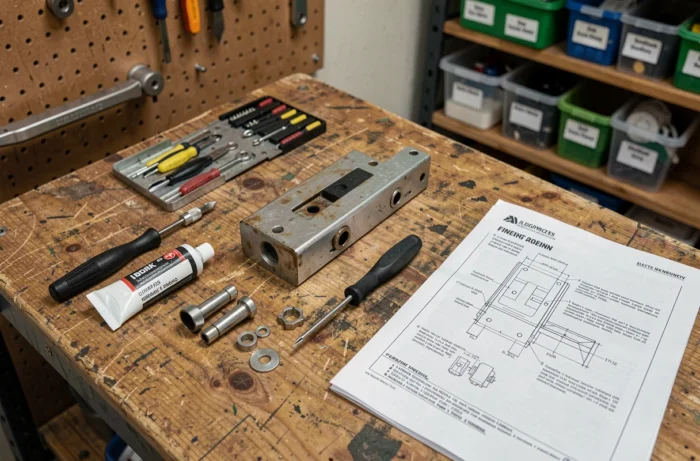
Cleaning and lubrication of the embedded strike mechanism
The primary cause of failure in an embedded strike remains the accumulation of fine dust and metal shavings in the latch housing. The embedded casing, being semi-closed by nature, traps these particles with each opening cycle.
Cleaning protocol adapted to the type of strike
We systematically use dry compressed air (fine nozzle, moderate pressure) to dislodge debris from the casing without disassembling the strike head. An anti-static brush completes the operation on the electrical contacts. Aggressive solvents should be avoided: they degrade internal seals and protective coatings against corrosion.
- Blow out the inside of the embedded casing to remove dust and metal debris, keeping the strike powered to verify that the latch retracts freely after cleaning.
- Clean the electrical contacts with a specific contact spray (non-greasy residue) to ensure the continuity of the impulse signal.
- Apply a dry lubricant based on PTFE to moving parts, never thick grease which traps dust and accelerates soiling.
- Check the condition of the perimeter seal of the casing, especially on outdoor installations (door, gate) exposed to the elements.
A dry lubricant based on PTFE is the only suitable option for the moving parts of an embedded strike. Mineral or thick silicone greases create a sticky film that captures particles and accelerates wear. The frequency of lubrication depends on the number of daily cycles: a building door used several dozen times a day requires intervention every three to four months.
Control of electrical supply and wiring
An intermittent malfunction of the strike often originates from the power circuit, not the mechanism itself. We regularly observe voltage drops on wiring that is too long or undersized, particularly during renovations where the existing cable has been extended without recalculating the cross-section.
Control points on the power circuit
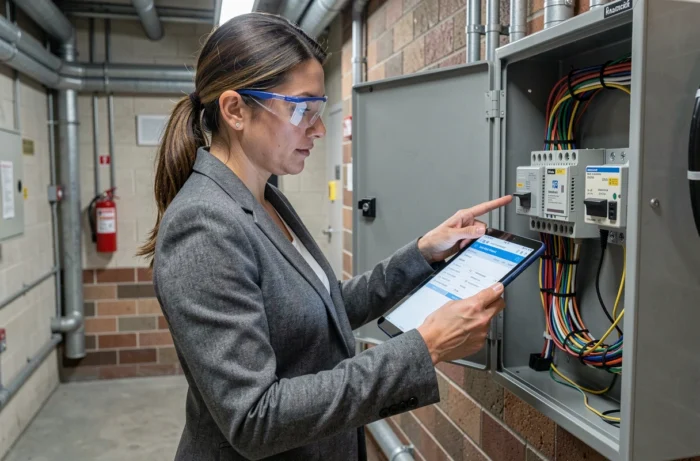
The voltage measured at the terminals of the strike, under load, must correspond to the range indicated by the manufacturer. A deviation of a few volts is enough to make unlocking erratic, especially on models with impulse operation that require a brief but stable current peak.
Connections using terminal blocks or Wagos located in the door frame are a classic weak point. Repeated vibrations gradually loosen the contacts. We recommend crimp connectors or screw terminals with a locknut for any embedded installation subjected to intensive use.
Check the voltage under load at the terminals of the strike, not just when unloaded. A measurement when unloaded may show a correct nominal value while the voltage drops at the moment of the impulse, making unlocking erratic.
Adjustment of latch-strike alignment after installation or sagging
A misalignment between the latch and the embedded strike generates lateral mechanical stress with each cycle. The latch rubs against the edge of the housing instead of engaging freely, which prematurely wears the retraction cam and can damage the electromagnet due to overload.
The most common cause is sagging of the door leaf, even by a few millimeters, due to settling of the hinges or play in the fittings. Before adjusting the strike, we systematically check the play of the door leaf and the condition of the hinges. Realigning the door often resolves the issue without intervention on the casing.
Quick diagnostic method
- Apply masking tape on the strike head and operate the door several times: the friction marks indicate the direction of the misalignment.
- Measure the play between the latch and the upper and lower edges of the strike housing: an asymmetrical gap confirms the misalignment.
- Adjust the position of the strike in its housing by modifying the mortise, or use the elongated fixing holes if the model allows it.
On strikes with current emission or interruption, chronic misalignment eventually stresses the electromagnet beyond its nominal capabilities. The coil heats up, the internal resistance increases, and the device loses responsiveness before failing completely.
Proper maintenance of an embedded electric strike relies on three pillars: regular cleaning of the casing, checking the power circuit under load, and monitoring the latch-strike alignment. Neglecting any of these aspects amounts to treating symptoms without correcting the cause. In ERP installations, formalizing each intervention in the safety register remains an obligation that routine does not exempt from respecting.