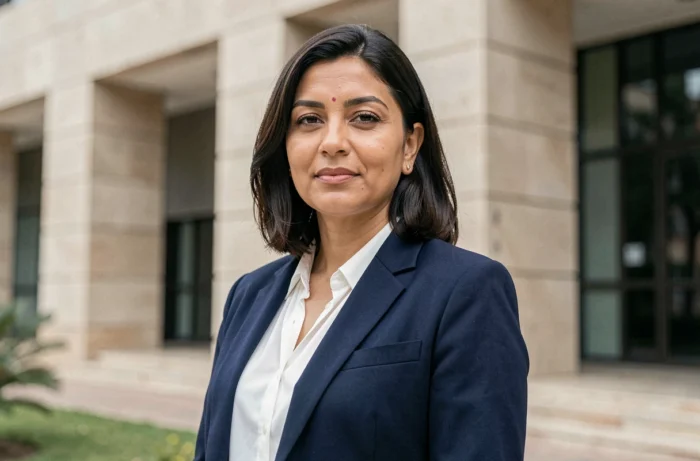
Najwa El Haïté is a doctor of public law, lawyer, and local elected official. Her political and legal background constitutes the verifiable foundation of her biography, much more than the family information that circulates online without a documented source chain.
Traceability of sources on Najwa El Haïté’s family origins
Most online biographies attribute Moroccan origins to Najwa El Haïté, mention a father who is a welder in a shipyard, and a stay-at-home mother, and sometimes cite a familial link to Hakima El Haïté, former Moroccan Minister of the Environment. The issue lies in how this information spreads.
No primary source confirms a specific country of origin for her parents. Search results mix press pages, promotional content, and unsourced rewrites. Each new site repeats the same claims without ever indicating where they come from: no direct interview, no civil status document, nor any public statement from the individual on this specific subject.
This mechanism of circular repetition is common for second-tier public figures. An initial article presents information, subsequent ones cite it as established, and the repetition eventually serves as proof. For anyone interested in the origin and biography of Najwa El Haïté, this lack of traceability should encourage caution rather than certainty.
Professional background and training in public law
It is in the legal and political field that Najwa El Haïté’s biography is based on verifiable elements. Doctor of public law, she obtained a law degree with a specialization in public freedoms. Her training directed her towards the bar, and then towards local political engagement.
Her activity as a lawyer and her media appearances constitute the best-documented part of her career. She regularly addresses issues of criminal law, secularism, and criminal policy, particularly on television sets.
Local political commitments
Najwa El Haïté has held responsibilities as a local elected official in Essonne, notably in Évry-Courcouronnes. She has also been identified as the vice-president of Territoires de Progrès, a political movement affiliated with the presidential majority.
- Municipal elected official in Essonne, with functions as deputy mayor
- Vice-president of Territoires de Progrès, placing her within the social-democratic field
- Frequent media appearances on criminal justice and secularism
These elements can be corroborated by press articles (Le Parisien, La Gazette des communes) and television segments. Her public identity is built through her positions, not through her ancestry.
Private life and family: what is actually documented
The demand for information about Najwa El Haïté’s private life, salary, or children often arises in searches. The keywords associated with her name systematically include “family,” “origins,” “private life,” “children.”
We observe that this curiosity is rarely satisfied by reliable sources. Information about her family life remains unconfirmed by primary sources. No interview published in a reputable media outlet details her family situation beyond what she chooses to make public in her appearances.
Why so much unsourced content circulates
The economic model of biographical sites relies on search volume. A name associated with queries like “origins,” “salary,” or “husband” generates traffic. Producing an article that responds to these queries, even with approximate information, remains profitable for these platforms.
This phenomenon is not unique to Najwa El Haïté. It affects the majority of local political figures or emerging media personalities. The difference between a rigorous biography and SEO-optimized content lies in a simple criterion: the presence or absence of named and verifiable sources.

Najwa El Haïté in the public debate: secularism and criminal policy
Her most documented interventions focus on two axes. The first concerns secularism and republican integration, topics on which she adopts a firmly universalist stance. The second touches on criminal policy, where she takes a position on recidivism and victims’ rights.
During an intervention on CNEWS, she stated that she was “outraged by the remarks of this mother whose son is a recidivist,” illustrating a stance that prioritizes individual responsibility. This type of position, widely shared on social media, contributes more to shaping her notoriety than any information about her family origins.
- Defense of a strict conception of secularism in public debate
- Positioning in favor of a firm penal response to recidivism
- Use of television media and social networks as main platforms
Her background as a lawyer and jurist establishes her media legitimacy, far more than the family biographical elements that search engines highlight.
Najwa El Haïté’s biography would benefit from being read through her concrete commitments rather than through family origins reproduced without verification. The verifiable information pertains to her training in public law, her local mandates in Essonne, and her interventions in the debate on secularism and criminal policy. The rest, at this stage, falls under editorial speculation.